

The pandemic’s impacts on our campus research ecosystem are many and varied. In his
guest blog, computer scientist Charles Wallace shares how not meeting in person illuminated
a new opportunity.
For more than a decade, our tutors in the Building Adult Skills in Computing (BASIC) program met face to face with people in the community to help them become more digitally competent
and confident. A big part of our success was the in-person aspect of our tutoring;
personal contact relieved anxiety among learners and helped tutors better understand
their issues.
The pandemic ended that. But it also revealed a new opportunity. For our Breaking Digital Barriers research group, the pandemic’s demand for digital literacy served as a calling.
Challenge: Rural Communities Need Digital Infrastructure
The COVID-19 pandemic literally shut the doors on our operation, as the community
centers that supported us were forced to close temporarily, eliminating the physical
proximity between tutor and learner that had been so important in our work. Nevertheless,
we made the decision to move to an all-online format, using Zoom and its screen-sharing
functionality to give us access. To our surprise, we encountered an explosion in interest,
as many people who had never attended BASIC sessions found themselves in need of online
communication. Helping someone navigate the Zoom installation process by phone is
a delicate procedure that I described in an earlier Unscripted article.
Our long-held suspicions were confirmed: Our in-person tutoring sessions were reaching
only a fraction of the population who needed it. Indeed, some of the people most in
need, without the means to travel to our physical locations, were among those being
left out.
The opportunity waiting for us in the COVID-19 crisis was a chance to rethink the
tutor-learner relationship. While there is nothing quite like helping people in person,
what if we could provide a user experience where tutors interacted with learners directly
through their devices — in a sense, having a live tutor “inside” the device? This
would allow our digital assistance to grow substantially, reaching people who did
not have the ability to attend live help sessions easily, and allowing for in-place
assistance at people’s homes or workplaces. This idea is at the heart of our Illuminated
Devices project, which has just received funding from the National Science Foundation
(NSF) through the new Strengthening American Infrastructure program.
Solution: Illuminated Devices Offer Interdisciplinary Help
The Illuminated Devices user experience involves a lightweight digital portal on a
learner’s digital device, providing a direct connection to human tutors that is accessible
even to those with no previous experience with digital devices. The Illuminated Portal
is a browser-based application that integrates communication with a human tutor and
access to common solutions that can help resolve problems independently. The portal
provides tutors with a continuous view of user activity across applications and conveys
tutor input to learners. The full Illuminated Devices system consists of a technical
subsystem (the device and the portal) and a social subsystem (the human tutors, community,
procedures and tasks associated with the tutoring program).
To me, the origin story of Illuminated Devices illustrates how diversity of expertise
within a research team can produce results that no single member could hope to attain.
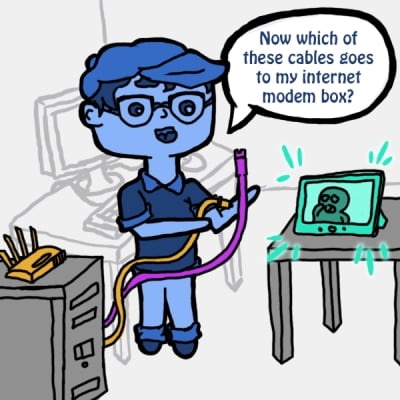

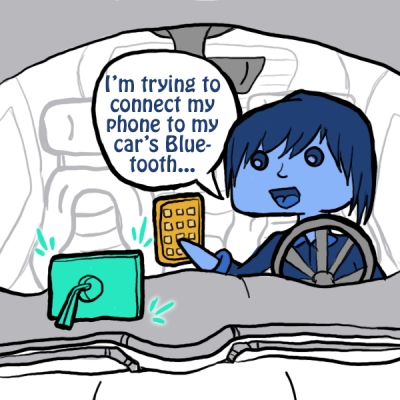
helper can assist people with questions like how to set up email accounts. Comic credit:
Briana Bettin
When BASIC stopped meeting in person, Kelly Steelman, associate professor and chair
of the Department of Cognitive and Learning Sciences (CLS), put her training at the
Stanford d.school to use by leading a group of BASIC tutors, patrons and other partners
through a design thinking workshop that resulted in the Illuminated Devices concept.
Briana Bettin, assistant professor in both the Department of Computer Science (CS)
and CLS, used her experience in user experience (UX) design to better understand the
contexts of use for Illuminated Devices — including some compelling visualizations
and comics that leveraged her considerable artistic talent. Leo Ureel, also an assistant
professor in both CS and CLS, brought experience in developing intelligent tutoring
systems and using them in educational contexts — particularly his WebTA tool, which
has been used extensively in the introductory computer science courses at Michigan
Tech. This diversity is particularly well suited to problems like the one revealed
to us through COVID-19, in which a radical new approach rather than optimization of
the existing system was needed.
Next Steps: Digital Literacy Builds Community
The Illuminated Devices approach opens a number of capabilities we are excited to
explore.
- We can reach learners in locations that are difficult or impossible for us to reach
physically. - We can continue to provide tutoring in the eventuality of a COVID-19 resurgence or
similar health crisis. - Learners can use their devices as communication tools when seeking help with digital
problems outside the device itself; for instance, setting up a cable modem or wireless
router or connecting a smartphone to a vehicle via Bluetooth. - We can combine in-person tutoring sessions with follow-up remote assistance through
the system.
Moving further, we will investigate the potential of capturing tutor expertise in
an AI-enabled system, thereby providing access to assistance even when human tutors
are not available.
Our work is informed by the staff and patrons of some of the community organizations
we have partnered with in the past: the Portage Lake District Library in Houghton, the Ojibwa Community Library in Baraga and the Hancock office of the Michigan Works job seeker assistance agency. The two-year project will involve pilot testing at all three community sites, where
we will evaluate the effectiveness of the Illuminated Devices system in increasing
learners’ competence and confidence. Our local work will lay a foundation for Illuminated
Devices to play a nationwide role in empowering digital citizens and strengthening
digital infrastructure.
I find it both exciting and appropriate for the Illuminated Devices project to be
funded by an NSF program centered on building infrastructure. Initiatives to bridge the digital divide in our nation tend to focus on access to the physical components of digital connectivity,
like high-speed internet and personal digital devices. Access is essential, but so
are digital skills and attitudes. Making an analogy to more old-fashioned infrastructure,
building new roads has little benefit for those who cannot or will not drive.
Reflecting on Einstein’s well-known dictum, “In the midst of every crisis lies great
opportunity,” I think there are some clear reasons why the COVID-19 pandemic strengthened
our research program. It alerted us to the many people in need whom we had been missing.
By depriving us of physical contact with our learners, it caused us to experience
the isolation that many on the other side of the digital divide face. It forced us
to move to a remote, all-digital tutoring format — something we had resisted for some
time, yet which proved to be more flexible and effective than we would have imagined.
All of these factors have informed our illuminated approach.
Michigan Technological University is a public research university founded in 1885 in Houghton, Michigan, and is home to more than 7,000 students from 55 countries around the world. Consistently ranked among the best universities in the country for return on investment, the University offers more than 125 undergraduate and graduate degree programs in science and technology, engineering, computing, forestry, business and economics, health professions, humanities, mathematics,…