

This report makes the case for expanding computer science education in primary and secondary schools around the world, and outlines the key challenges standing in the way. Through analysis of regional and national education systems at various stages of progress in implementing computer science education programs, the report offers transferable lessons learned across a wide range of settings with the aim that all students—regardless of income level, race, or sex—can one day build foundational skills necessary for thriving in the 21st century.

Access to education has expanded around the world since the late 1990s through the combined efforts of governments, bilateral and multilateral agencies, donors, civil society, and the private sector, yet education quality has not kept pace. Even before the COVID-19 pandemic led to school closures around the world, all young people were not developing the broad suite of skills they need to thrive in work, life, and citizenship (Filmer, Langthaler, Stehrer, & Vogel, 2018).
The impact of the pandemic on education investment, student learning, and longer-term economic outcomes threatens not only to dial back progress to date in addressing this learning crisis in skills development but also to further widen learning gaps within and between countries. Beyond the immediate and disparate impacts of COVID-19 on students’ access to quality learning, the global economic crisis it has precipitated will shrink government budgets, potentially resulting in lower education investment and impacting the ability to provide quality education (Vegas, 2020). There is also a concern that as governments struggle to reopen schools and/or provide sufficient distance-learning opportunities, many education systems will focus on foundational skills, such as literacy and numeracy, neglecting a broader set of skills needed to thrive in a rapidly changing, technologically-advanced world.
Among these broader skills, knowledge of computer science (CS) is increasingly relevant. CS is defined as “the study of computers and algorithmic processes, including their principles, their hardware and software designs, their [implementation], and their impact on society” (Tucker, 2003).1 CS skills enable individuals to understand how technology works, and how best to harness its potential to improve lives. The goal of CS education is to develop computational thinking skills, which refer to the “thought processes involved in expressing solutions as computational steps or algorithms that can be carried out by a computer” (K-12 Computer Science Framework Steering Committee, 2016). CS education is also distinct from computer or digital literacy, in that it is more concerned with computer design than with computer use. For example, coding is a skill one would learn in a CS course, while creating a document or slideshow presentation using an existing program is a skill one would learn in a computer or digital literacy course.
Research has shown that students benefit from CS education by increasing college enrollment rates and developing problem-solving abilities (Brown & Brown, 2020; Salehi et al., 2020). Research has also shown that lessons in computational thinking improve student response inhibition, planning, and coding skills (Arfé et al., 2020). Importantly, CS skills pay off in the labor market through higher likelihood of employment and better wages (Hanson & Slaughter, 2016; Nager & Atkinson, 2016). As these skills take preeminence in the rapidly changing 21st century, CS education promises to significantly enhance student preparedness for the future of work and active citizenship.
The benefits of CS education extend beyond economic motivations. Given the increasing integration of technology into many aspects of daily life in the 21st century, a functional knowledge of how computers work—beyond the simple use of applications—will help all students.

By this point, many countries have begun making progress toward offering CS education more universally for their students. The specific reasons for offering it will be as varied as the countries themselves, though economic arguments often top the list of motivations. Other considerations beyond economics, however, are also relevant, and we account for the most common of these varied motives here.
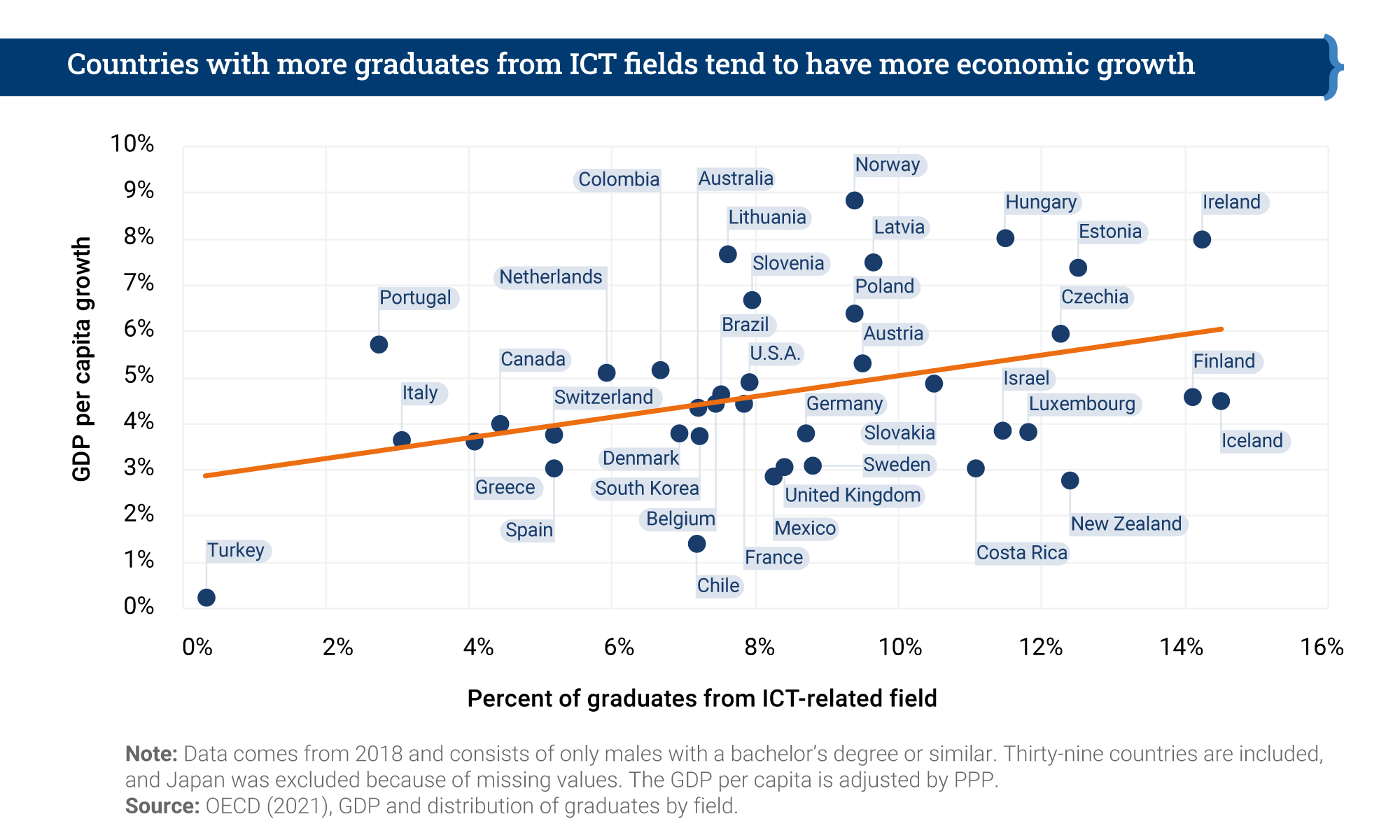
At the macroeconomic level, previous research has suggested that countries with more workers with ICT (information, communications, and technology) skills will have higher economic growth through increases in productivity (Maryska, Doucek, & Kunstova, 2012; Jorgenson & Vu, 2016). Recent global data indicate that there is a positive relationship between the share of a country’s workforce with ICT skills and its economic growth. For example, using data from the Organisation for Economic Cooperation and Development (OECD), we find that countries with a higher share of graduates from an ICT field tend to have higher rates of per capita GDP (Figure 1). The strength of the estimated relationship here is noteworthy: A one percentage point increase in the share of ICT graduates correlates with nearly a quarter percentage point increase in recent economic growth, though we cannot determine the causal nature of this relationship (if any). Nonetheless, this figure supports the common view that economic growth follows from greater levels of investment in technological education.
At the microeconomic level, CS skills pay off for individuals—both for those who later choose to specialize in CS and those who do not. Focusing first on the majority of students who pursue careers outside of CS, foundational training in CS is still beneficial. Technology is becoming more heavily integrated across many industrial endeavors and academic disciplines—not just those typically included under the umbrella of science, technology, engineering, and mathematics (STEM) occupations. Careers from law to manufacturing to retail to health sciences all use computing and data more intensively now than in decades past (Lemieux, 2014). For example, using data from Germany, researchers showed that higher education programs in CS compared favorably against many other fields of study, producing a relatively high return on investment for lower risk (Glocker and Storck, 2014). Notably, completing advanced training in CS is not necessary to attain these benefits; rather, even short introductions to foundational skills in CS can increase young students’ executive functions (Arfe et al., 2020). Further, those with CS training develop better problem-solving abilities compared to those with more general training in math and sciences, suggesting that CS education offers unique skills not readily developed in other more common subjects (Salehi et al., 2020).
For those who choose to pursue advanced CS studies, specializing in CS pays off both in employment opportunities and earnings. For example, data from the U.S. show workers with CS skills are less likely to be unemployed than workers in other occupations (Figure 2). Moreover, the average earnings for workers with CS skills are higher than for workers in other occupations (Figure 3). These results are consistent across multiple studies using U.S. data (Carnevale et al., 2013; Altonji et al., 2012) and international data (Belfield et al., 2019; Hastings et al., 2013; Kirkeboen et al., 2016). Further, the U.S. Bureau of Labor Statistics has projected that the market for CS professionals will continue to grow at twice the speed of the rest of the labor market between 2014 and 2024 (National Academies of Sciences, 2018).


A common, though inaccurate, perception about the CS field is that anybody with a passion for technology can succeed without formal training. There is a nugget of truth in this view, as many leaders of major technology companies including Bill Gates, Elon Musk, Mark Zuckerberg, and many others have famously risen to the top of the field despite not having bachelor’s degrees in CS. Yet, it is a fallacy to assume that these outliers are representative of most who are successful in the field. This misconception could lead observers to conclude that investments in universal CS education are, at best, ineffective: providing skills to people who would learn them on their own regardless, and spending resources on developing skills in people who will not use them. However, such conclusions are not supported by empirical evidence. Rather, across STEM disciplines, including CS, higher levels of training and educational attainment lead to stronger employment outcomes, on average, than those with lesser levels of training in the same fields (Altonji et al., 2016; Altonji and Zhong, 2021).
Technology—and particularly unequal access to its benefits—has been a key driver of social and economic inequality within countries. That is, those with elite social status or higher wealth have historically gotten access to technology first for their private advantages, which tends to reinforce preexisting social and economic inequalities. Conversely, providing universal access to CS education and computing technologies can enable those with lower access to technological resources the opportunity to catch up and, consequently, mitigate these inequalities. Empirical studies have shown how technological skills or occupations, in particular, have reduced inequalities between groups or accelerated the assimilation of immigrants (Hanson and Slaughter, 2017; DeVol, 2016).
Technology and CS education are likewise frequently considered critical in narrowing income gaps between developed and developing countries. This argument can be particularly compelling for low-income countries, as global development gaps will only be expected to widen if low-income countries’ investments in these domains falter while high-income countries continue to move ahead. Rather, strategic and intensive technological investment is frequently seen as a key strategy for less-developed countries to leapfrog stages of economic development to quickly catch up to more advanced countries (Fong, 2009; Lee, 2019).
CS skills enable adaptation in a quickly changing world, and adaptability is critical to progress in society and the economy. Perhaps there is no better illustration of the ability to thrive and adapt than from the COVID-19 pandemic. The pandemic has forced closures of many public spaces across the globe, though those closures’ impacts have been disproportionately felt across workers and sectors. Workers with the skills and abilities to move their job functions online have generally endured the pandemic more comfortably than those without those skills. And even more importantly, the organizations and private companies that had the human capacity to identify how technology could be utilized and applied to their operations could adapt in the face of the pandemic, while those without the resources to pivot their operations have frequently been forced to close in the wake of pandemic-induced restrictions. Thus, the pandemic bestowed comparative benefits on those with access to technology, the skills to use it, and the vision to recognize and implement novel applications quickly, while often punishing those with the least access and resources (OECD, 2021).
Failing to invest in technology and CS education may result in constrained global competitiveness, leaving governments less able to support its citizens. We recognize that efforts to expand CS education will demand time and money of public officials and school leaders, often in the face of other worthy competing demands. Though the contemporary costs may even seem prohibitive in some cases, the costs of inaction (while less immediately visible) are also real…
How to expand and improve computer science education around the world