
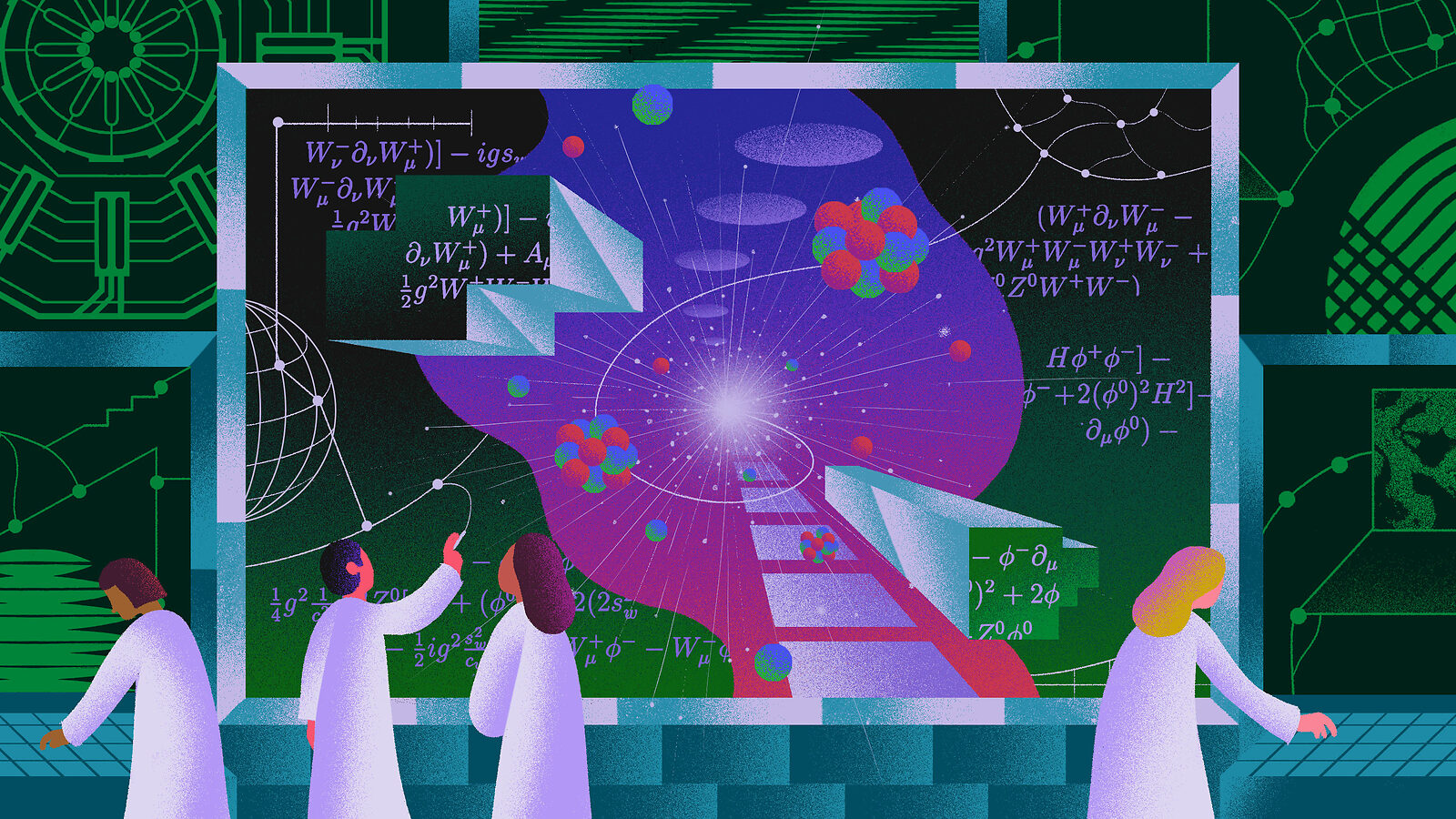
In the mid-twentieth century, particle physicists were peering deeper into the history and makeup of the universe than ever before. Over time, their calculations became too complex to fit on a blackboard—or to farm out to armies of human “computers” doing calculations by hand.
To deal with this, they developed some of the world’s earliest electronic computers.
Physics has played an important role in the history of computing. The transistor—the switch that controls the flow of electrical signal within a computer—was invented by a group of physicists at Bell Labs. The incredible computational demands of particle physics and astrophysics experiments have consistently pushed the boundaries of what is possible. They have encouraged the development of new technologies to handle tasks from dealing with avalanches of data to simulating interactions on the scales of both the cosmos and the quantum realm.
But this influence doesn’t just go one way. Computing plays an essential role in particle physics and astrophysics as well. As computing has grown increasingly more sophisticated, its own progress has enabled new scientific discoveries and breakthroughs.
Illustration by Sandbox Studio, Chicago with Ariel Davis
Managing an onslaught of data
In 1973, scientists at Fermi National Accelerator Laboratory in Illinois got their first big mainframe computer: a 7-year-old hand-me-down from Lawrence Berkeley National Laboratory. Called the CDC 6600, it weighed about 6 tons. Over the next five years, Fermilab added five more large mainframe computers to its collection.
Then came the completion of the Tevatron—at the time, the world’s highest-energy particle accelerator—which would provide the particle beams for numerous experiments at the lab. By the mid-1990s, two four-story particle detectors would begin selecting, storing and analyzing data from millions of particle collisions at the Tevatron per second. Called the Collider Detector at Fermilab and the DZero detector, these new experiments threatened to overpower the lab’s computational abilities.
In December of 1983, a committee of physicists and computer scientists released a 103-page report highlighting the “urgent need for an upgrading of the laboratory’s computer facilities.” The report said the lab “should continue the process of catching up” in terms of computing ability, and that “this should remain the laboratory’s top computing priority for the next few years.”
Instead of simply buying more large computers (which were incredibly expensive), the committee suggested a new approach: They recommended increasing computational power by distributing the burden over clusters or “farms” of hundreds of smaller computers.
Thanks to Intel’s 1971 development of a new commercially available microprocessor the size of a domino, computers were shrinking. Fermilab was one of the first national labs to try the concept of clustering these smaller computers together, treating each particle collision as a computationally independent event that could be analyzed on its own processor.
Like many new ideas in science, it wasn’t accepted without some pushback.
Joel Butler, a physicist at Fermilab who was on the computing committee, recalls, “There was a big fight about whether this was a good idea or a bad idea.”
A lot of people were enchanted with the big computers, he says. They were impressive-looking and reliable, and people knew how to use them. And then along came “this swarm of little tiny devices, packaged in breadbox-sized enclosures.”
The computers were unfamiliar, and the companies building them weren’t well-established. On top of that, it wasn’t clear how well the clustering strategy would work.
As for Butler? “I raised my hand [at a meeting] and said, ‘Good idea’—and suddenly my entire career shifted from building detectors and beamlines to doing computing,” he chuckles.
Not long afterward, innovation that sparked for the benefit of particle physics enabled another leap in computing. In 1989, Tim Berners-Lee, a computer scientist at CERN, launched the World Wide Web to help CERN physicists share data with research collaborators all over the world.
To be clear, Berners-Lee didn’t create the internet—that was already underway in the form the ARPANET, developed by the US Department of Defense. But the ARPANET connected only a few hundred computers, and it was difficult to share information across machines with different operating systems.
The web Berners-Lee created was an application that ran on the internet, like email, and started as a collection of documents connected by hyperlinks. To get around the problem of accessing files between different types of computers, he developed HTML (HyperText Markup Language), a programming language that formatted and displayed files in a web browser independent of the local computer’s operating system.
Berners-Lee also developed the first web browser, allowing users to access files stored on the first web server (Berners-Lee’s computer at CERN). He implemented the concept of a URL (Uniform Resource Locator), specifying how and where to access desired web pages.
What started out as an internal project to help particle physicists share data within their institution fundamentally changed not just computing, but how most people experience the digital world today.
Back at Fermilab, cluster computing wound up working well for handling the Tevatron data. Eventually, it became industry standard for tech giants like Google and Amazon.
Over the next decade, other US national laboratories adopted the idea, too. SLAC National Accelerator Laboratory—then called Stanford Linear Accelerator Center—transitioned from big mainframes to clusters of smaller computers to prepare for its own extremely data-hungry experiment, BaBar. Both SLAC and Fermilab also were early adopters of Lee’s web server. The labs set up the first two websites in the United States, paving the way for this innovation to spread across the continent.
In 1989, in recognition of the growing importance of computing in physics, Fermilab Director John Peoples elevated the computing department to a full-fledged division. The head of a division reports directly to the lab director, making it easier to get resources and set priorities. Physicist Tom Nash formed the new Computing Division, along with Butler and two other scientists, Irwin Gaines and Victoria White. Butler led the division from 1994 to 1998.
High-performance computing in particle physics and astrophysics
These computational systems worked well for particle physicists for a long time, says Berkeley Lab astrophysicist Peter Nugent. That is, until Moore’s Law started grinding to a halt.
Moore’s Law is the idea that the number of transistors in a circuit will double, making computers faster and cheaper, every two years. The term was first coined in the mid-1970s, and the trend reliably proceeded for decades. But now, computer manufacturers are starting to hit the physical limit of how many tiny transistors they can cram onto a single microchip.
Because of this, says Nugent, particle physicists have been looking to take advantage of high-performance computing instead.
Nugent says high-performance computing is “something more than a cluster, or a cloud-computing environment that you could get from Google or AWS, or at your local university.”
What it typically means, he says, is that you have high-speed networking between computational nodes, allowing them to share information with each other very, very quickly. When you are computing on up to hundreds of thousands of nodes simultaneously, it massively speeds up the process.
On a single traditional computer, he says, 100 million CPU hours translates to more than 11,000 years of continuous calculations. But for scientists using a high-performance computing facility at Berkeley Lab, Argonne National Laboratory or Oak Ridge National Laboratory, 100 million hours is a typical, large allocation for one year at these facilities.
For more than a decade, supercomputers like these have been providing theorists with the computing power to solve with high precision equations in quantum chromodynamics, enabling them to make predictions about the strong forces binding quarks into the building blocks of matter.
And although astrophysicists have always relied on high-performance computing for simulating the birth of stars or modeling the evolution of the cosmos, Nugent says they are now using it for their data analysis as well.
This includes rapid image-processing computations that have enabled the observations of several supernovae, including SN 2011fe, captured just after it began. “We found it just a few hours after it exploded, all because we were able to run these pipelines so efficiently and quickly,” Nugent says.
According to Berkeley Lab physicist Paolo Calafiura, particle physicists also use high-performance computing for simulations—for modeling not the evolution of the cosmos, but rather what happens inside a particle detector. “Detector simulation is significantly the most computing-intensive problem that we have,” he says.
Scientists need to evaluate multiple possibilities for what can happen when particles collide. To properly correct for detector effects when analyzing particle detector experiments, they need to simulate more data than they collect. “If you collect 1 billion collision events a year,” Calafiura says, “you want to simulate 10 billion collision events.”
Calafiura says that right now, he’s more worried about finding a way to store all of the simulated and actual detector data than he is about producing it, but he knows that won’t last.
“When does physics push computing?” he says. “When computing is not good enough… We see that in five years, computers will not be powerful enough for our problems, so we are pushing hard with some radically new ideas, and lots of detailed optimization work.”
That’s why the Department of Energy’s Exascale Computing Project aims to build, in the next few years, computers capable of performing a quintillion (that is, a billion billion) operations per second. The new computers will be 1000 times faster than the current fastest computers.
The exascale computers will also be used for other applications ranging from precision medicine to climate modeling to national security.
Machine learning and quantum computing
Innovations in computer hardware have enabled astrophysicists to push the kinds of simulations and analyses they can do. For example, Nugent says, the introduction of graphics processing units has sped up astrophysicists’ ability to do calculations used in machine learning, leading to an explosive growth of machine learning in astrophysics.
With machine learning, which uses algorithms and statistics to identify patterns in data, astrophysicists can simulate entire universes in microseconds.
Machine learning has been important in particle physics as well, says Fermilab scientist Nhan Tran. “[Physicists] have very high-dimensional data, very complex data,” he says. “Machine learning is an optimal way to find interesting structures in that data.”
The same way a computer can be trained to tell the difference between cats and dogs in pictures, it can learn how to identify particles from physics datasets, distinguishing between things like pions and photons.
Tran says using computation this way can accelerate discovery. “As physicists, we’ve been able to learn a lot about particle physics and nature using non-machine-learning algorithms,” he says. “But machine learning can drastically accelerate and augment that process—and potentially provide deeper insight into the data.”
And while teams of researchers are busy building exascale computers,…