

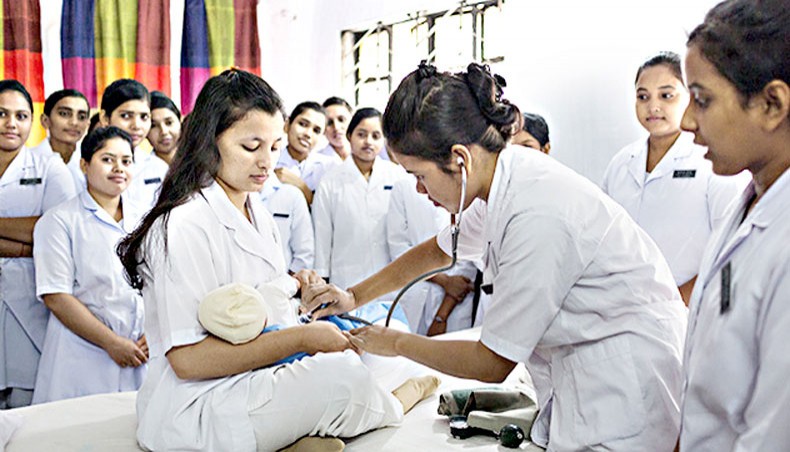
A midwifery student plays the role of a mother as students practise post-natal care at the Dinajpur Nursing Institute. — UNFPA/Nicolas Axelrod
NURSES are the most numerous and vital professional healthcare providers and the demand for their services continue to grow. To produce qualified nurses, quality education is fundamental. In Bangladesh, different institutes now produce nurses but in reality, they do not provide services up to the mark as there are lapses and gaps in their learning system. Hence, reforms in nursing education system in Bangladesh is a burning issue.
For reformation, adequate research on the way forward is essential. Similarly essential is the focus on the thinking of urban planners and healthcare practitioners for the way forward of the present nursing education system. Nursing admission results of 2021 has already been published and the institutes started classes on November 1, 2021. So, this is high time to discuss how the teaching system should continue.


During several field visits, we observed that a lot of nurses do not know how to fill up the partograph correctly. They even do not know the use of magnesium sulphate, or MgSO4, for eclampsia and pre-eclampsia patients. In case of the active management of the third stage of labour, some use both misoprostol and oxytocin. Some nurses have no proper idea regarding recording and reporting. Hence, there must be a lapse in their education. A well-educated nursing force with adequate professional training can be a resource for the country.
To become a registered nurse in most countries, former education with more extensive professional training is required. Many countries have introduced several theoretical and practical training for nursing students in hospitals, or via a pre-registration nursing programme at a university or college. Nursing students, thus educated and trained, demonstrate higher competency in nursing practice, communication, leadership, professional integration, and research/evaluation.
Urban planners in Bangladesh are concerned about urban health and emphasise the necessity of an ideal education system in the nursing institutes to produce quality nurses and midwives. Fifteen urban planners were surveyed through key informant interview. For an ideal nursing education system, they say, (a) there should be high quality faculty members. In some institutes, senior staff nurses become teachers. They are required because they have the exact experience of professional dealings but the combination of MBBS doctors and professional nurses as teachers is crucial to imparting in-depth knowledge; (b) in European countries, group study opportunity is provided for nursing students, but in Bangladesh it is rare. Group study should be facilitated as it creates the opportunity for mutual learning. Research shows that students who study with peers retain approximately 70 per cent of what they learn, as opposed to just 20 per cent of what they hear in class alone and just 10 per cent of what they read.
Studying with others helps provide encouragement and moral support; (c) attractive learning system needs to be introduced by imparting audio-visual learning system; (d) professional experts need to be hired as faculty. Professional experts may be physicians or from other professions who have couple of years’ experience dealing with the nurses and midwives because they know the limitations of the current nurses and they can provide better guidance to the present students to produce quality nurses in near future; (e) nursing students should engage in some basic social research such as people’s satisfaction survey. This example is given as the students will deal with people in society and if they know people’s expectations from them, this will be helpful for their future dealings.
For doing so, basic research methodology and fundamental statistics need to be introduced in their course curriculum; (f) students need to get training in basic computer software such as MS package or SPSS which will be helpful for them to maintain recording and reporting in their professional life; (g) a portion of present students will work under the government settings so they should be provided adequate knowledge regarding recording and reporting system of the Directorate General of Family Planning and the Directorate General of Health Services; (h) in reality, it is observed that some current nurses and midwives do not know the standard operating protocols, which is very essential for the delivery of quality services.
It is, therefore, necessary that students orient themselves the standard protocols, (i) the nursing institutes should offer some practical sessions for the students to gear up their learning. For this, the students can be attached with some health facilities from their student life.
Moreover, physicians are also concerned about the ideal education system in nursing institutes to produce quality nurses and midwives. Fifteen physicians were surveyed too. For an ideal nursing education system, they emphasise (a) motivating students to use downtime as study time. Nursing studies require a certain level of memorisation; (b) introducing group study system in the institute. Key informants suggested that making groups with three students is better for utmost learning; (c) introducing nursing ethics in course curriculum is very much essential to develop moral values; (d) providing students free internet facility for a certain period for the purpose of study; (e) teaching the students to think in terms of action, not facts.
It is important for nurses to understand why certain conditions occur and what is happening physiologically in a patient and what immediately needs to be done for the initial stabilisation of the patients; (f) providing video demonstration of national and international success stories to the students for better learning; (g) organising frequent seminars for the students to impart them with the knowledge of different experts; (h) introducing the students with the job aids because these materials are important for guided service delivery. For instance, if the danger sign poster of mother is available in front of the caregivers, they can easily trace the condition of the mother without remembering everything and will be capable of providing correct and timely services; (i) organising stress management training for the students which will be helpful during their student life to manage their study pressure as well as in professional life they will also be able to manage the job stress; and (j) encouraging the use of and providing outside resources. For example, if students learn about diabetes, encourage them to review the Mayo Clinic, WebMD and American Diabetes Association websites to learn more.
The recommendations of urban planners and physicians are very crucial to producing quality nurses and midwives and we expect that the government will take necessary steps to ensure the suggestions of the experts and will make the education system of all nursing institutes ideal. The government should also take up research projects focusing on how to strengthen the nursing education system in the country as future nurses will take care our future population. The government can also conduct researches to develop a unified framework comparable to international standards for nursing education with the collaboration of the ministry of health and family welfare. This is high time to ensure a better future for citizens with a vision to achieve Sustainable Development Goal 3, ensuring healthy lives and promoting well-being for all at all ages.
Md Mahmud Hassan Talukdar is an urban planner, policy researcher and development professional. Dr Nurunnabi Faisal is a physician, Rangpur Community Medical College Hospital and deputy managing director, Kholahati Nursing Institute, Rangpur.